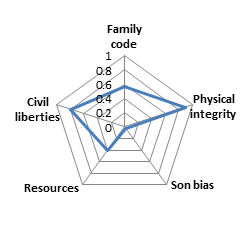
Article 11 of the Constitution of Liberia guarantees fundamental rights and freedoms for all, irrespective of sex.[1] However, there is no explicit definition of gender discrimination in either the Constitution or Liberian legislation.[2] Liberia ratified the Convention on the Elimination of All forms of Discrimination against Women (CEDAW) in 1984, but has not yet ratified the Optional Protocol on violence against women.[3]The country ratified the Protocol to the African Charter on Human and Peoples’ Rights on the Rights of Women in Africa in 2008.[4] In 2001, the government created a Ministry for Gender and Development, and a National Gender Policy is in place.[5]
[1] Idem, p.19 [2] CEDAW (2009b) p.2 [3] United Nations Treaty Collection (2013); CEDAW (2008) p.16 [4] African Union (2010) [5] CEDAW (2008) pp.25, 27
Civil and customary law are both recognised in Liberia under Article 65 of the Liberian Constitution. Customary law is, however, considered invalid if it violates constitutional provisions on non-discrimination or equality (art. 2 of the Constitution).[6] In addition, the 1998 Equal Rights of Customary Law criminalise acts such as compulsory marriage of widows to a deceased husband’s relative, and forced marriage.[7] Women who are married according to customary law are considered to be legal minors, and have little or no rights with regard to parental authority and inheritance, as well as a highly limited capacity to contribute towards decision-making within the household.[8]
Under the Domestic Relations Law, the minimum legal age for marriage is 18 years for women and 21 years for men[9] although the Equal Right of the Traditional Marriage Law of 1998 allows girls to marry at age 16.[10] 2008 Data from the UN reports that 20.2% of girls between 15 and 19 years of age were married, divorced or widowed.[11]Data on early marriage also reveals that among women age 25-49 at the time of the survey, 15.2% were married by the age of 15, 46.1% by the age of 18, and almost 75% by the age of 22,[12] suggesting that traditional practices of early and forced marriage continue.[13] In 2011 the Liberian Senate passed the Children Act and in 2012 the President signed it into law. That Act provides that children under the age of 18 cannot either be betrothed or promised for marriage, nor can they enter into marriage.[14]
Under civil law, both parents have equal parental authority and the right to shared custody in the event of divorce. According to customary law, however, married women have no right to parental authority and no right to custody of their children in the event of the father’s death or divorce.[15] The children instead join her husband’s family.[16]
Under Liberia’s civil law on inheritance, married women can inherit land and property. The 2003 Inheritance Act gives women married under customary law the same right to inherit.[17] In addition, under the Decedents Estates Law of 1972, sons and daughters have equal inheritance rights to property.[18] But in practice, there is little awareness of these laws and under customary law, married women are instead treated as property, and neither they nor their daughters can inherit, nor can wives return to their home of origin upon the death of their husband.[19] In addition, women cannot appear before traditional courts without their husbands.[20]
More
While Liberia’s civil law prohibits polygamy, customary law allows men to have several wives.[21] According to 2007 DHS data, 16% of women aged 15-49 were in polygamous relationships in Liberia.[22] Rates of polygyny were higher for older women (over 35) than for younger women,[23] giving some indication that the practice may be declining.
Both civil and customary law allow women to initiate divorce. Divorce, however, carries social stigma and women married under customary law who choose to divorce must also refund bride price to the groom, a significant impediment to women’s access to divorce.[24]In addition, a woman planning to divorce her husband and unwilling to submit to levirate marriage could lose access to both her children and property accumulated during marriage.[25]
The adolescent fertility rate in Liberia is quite high, with teenage girls contributing approximately 14% of the Total Fertility Rate in 2007. The age specific fertility rate of girls age 15-19 was 141 per 1000 women in that same year.[26]
When it comes to decision-making, the majority of cases (54%), women report that they and their husband decide jointed over how her cash-earnings are used.[27]When it comes to making major household purchases, again it is mostly the husband and wife decide jointly (40%), while decisions about daily household needs and cooking are made mainly by the wife (64.4%).[28]
[6] World Bank (2013) [7] CEDAW (2008) pp.21-22 [8] Idem, p.77 [9] CEDAW (2009a) p.16 [10] US State Department (2012) [11] OECD (2014), Gender, Institutions and Development Database, http://stats.oecd.org [12] DHS (2007) p.81 [13] CEDAW (2009b) p.7 [14] African Child Policy Forum (2013) [15] ECOSOC (2003) p.71 [16] Kte’pi, B. (2013) p.709 [17] CEDAW (2009b) p.7; CEDAW (2008) p.77 [18] World Bank (2013) [19] CEDAW (2008) p.77; CEDAW (2009c) p.6 [20] CEDAW (2009b) p.10 [21] US Department of State (2012) [22] DHS (2007) p.78 [23] Idem [24] Kte’pi, B. (2013) p.708 [25] Fuest, V. (2008) p.206 [26] DHS (2007) pp. 47-48 [27] Idem, p.207 [28] Idem, p.210
There is, similarly, no specific law in Liberia dealing with domestic violence, although a National Gender-Based Violence Plan of Action was adopted in 2006.[29]According to the 2007 Demographic and Health Survey (DHS), domestic violence appears to be widespread: 39% of women who were married or cohabiting reported having experienced at least one incident of physical or sexual violence at the hands of their husband or partner in their lifetime.[30]When presented with a list of five different ‘reasons’ for a man to beat his wife in the same survey, 59.3% of women agreed with at least one.[31]There are some government-run women’s refuges, but most support services are provided by women’s rights NGOS.[32]
In 2006, the government promulgated a new law that recognises rape as a crime (although does not recognise spousal rape), and imposes harsh penalties for perpetrators, particularly in cases of gang rape and where the victim is under 18.[33] The law is not effectively enforced, and where cases are brought, they are often settled out of court.[34] The new legislation was issued response to the systematic use of rape and sexual violence as a weapon of war throughout the civil conflict during the last decade of the 20th century and into the early 2000s, by rebel and government forces.[35] Many cases of rape go unreported, and the survivors do not seek help, because of the stigma surrounding sexual violence.[36] In addition, health facilities do not have the equipment, resources, or expertise to provide the assistance needed[37] and policy and the judiciary lack the capacity to response adequately, despite legislative, training and sensitization efforts,[38] including the enactment of the 2008 Gender and Sexually Based Violence Act, which provides for the establishment of a specialized court to try cases of sexual violence.[39] Since 2008, women’s NGOs are taking action to raise awareness about rape, organizing public manifestations, such as sit-ins.[40]
There is no specific law that addresses sexual harassment although a Labour Law entitled the “Decent Work Bill” is pending before the National Legislation. In the 2009 draft of this Bill, sexual harassment is defined as “sexual conduct which is unwelcome, unreasonable, or offensive to the recipient, and which occurs in circumstances where a person’s rejection of, or submission to, such conduct is used explicitly or implicitly as a basis for a decision which affects that person’s job; or ii) sexual conduct that creates an intimidating, hostile or humiliating working environment for the person that is subject to that conduct.”[41]A draft code of conduct for teachers is similarly pending approval. Under the latter, teachers convicted of sexual harassment face up to five years suspension without pay, while consecutive offences result in the expulsion from the profession.[42]
There is no law prohibiting female genital mutilation (FGM) in Liberia[43], although the current government has run nationwide campaigns to discourage the practice.[44] FGM is thought to be quite common particularly among ethnic groups in the north, west and centre of the country, and more generally in rural areas.[45] It is very difficult to ascertain accurate figures for the number of women who have undergone the procedure, because it is often carried out during initiation rituals into women’s secret societies or so-called ‘bush schools’.[46]Based on the numbers of women who say that they are members of such societies – and hence, are likely to have undergone FGM – it is estimated that 58.2% of Liberian women aged 15-49 have undergone FGM.[47]Using the same data, UNICEF estimates that 66% of women in Liberia have experienced some form of FGM, while 45% support its continuation.[48]
More
Abortion is only legal in Liberia on certain grounds, such as to save a woman’s life or preserve her mental health.[49]
There is no legislation restricting the right of women to access contraception and other reproductive health services.[50] Access to sexual and reproductive health services is provided free of charge at health facilities run by the government and International NGOs (INGOs).[51] According to the 2007 DHS, knowledge of at least one method of contraception is high among Liberian women – 86.8%, but actual usage is low: only 13.3% of women reported currently using any form of contraception; 11.7% were using a modern method.[52] With regard to family planning more broadly, 36% of women aged 15-49 have an unmet need for planning services[53]and the median age at first birth is 19.1.[54] Over 25% of adolescents age 15-19 have already had a child.[55]Overall, healthcare services and infrastructure were severely affected by the 14-year conflict, limiting women’s access to reproductive and general health services, particularly in rural areas.[56]
[29] CEDAW (2009a) p.8; CEDAW (2008) p.22 [30]OECD (2014), Gender, Institutions and Development Database, http://stats.oecd.org [31] Idem, p.215 [32] CEDAW (2008) p.38 [33] CEDAW (2008) pp. 16, 28; DHS (2007) p.225 [34] US State Department (2012) [35] CEDAW (2008) p.34; CEDAW (2009b) p.5[36]OECD (2014), Gender, Institutions and Development Database, http://stats.oecd.org [37] Idem [38] CEDAW (2009b) p.6 [39] US State Department (2012) [40] United Nations. (2008) [41] Decent Work Bill (2009) Draft 3 [42] CEDAW (2009c) p.3 [43] CEDAW (2009b) p.5 [44] CEDAW (2008) p.34 [45] Idem [46] Idem [47] CEDAW (2008) p.67; DHS (2007) pp.241-242 [48] UNICEF (2013) p.55 [49] Center for Reproductive Rights (2013) [50] US Department of State (2012) [51] CEDAW (2009a) p.13 [52] DHS (2007) p.62 [53] DHS (2007) p.95 [54] DHS (2007) p.53 [55] Idem [56] CEDAW (2008) p.60; CEDAW (2009a) p.14
The male-to-female sex ratio at birth in 2013 is 1.03 and for the working age population (15-64 years old) is 0.98. [57]
Liberia does not appear to be a country of concern in regard to missing women.
More
Vaccination rates for infants are higher for girls than boys (42.4% against 36.1%), and infant and child mortality rates in Liberia are slightly higher for boys than girls.[58] The same is true of malnutrition rates.[59]
In terms of access to education, the discrepancy between male and female school attendance rates at primary level is not very large, with 41.1% of boys and 38.6% of girls attending primary school.[60]Secondary school attendance rates for boys and girls are both low - 21.3% for boys and 17.9% for girls.[61] Again, this does not indicate marked son preference in relation to access to education, although a lack of physical infrastructure, persistence of gender-based stereotypes in textbooks and school curricula reinforce discriminatory attitudes towards women.[62] Early and forced marriages and adolescent pregnancies are also detrimental to girls’ access to schools.[63]
[57]CIA. https://www.cia.gov/library/publications/the-world-factbook/fields/2018.html (accessed 28/03/2014) [58] DHS (2007) pp.107, 126 [59] Idem, p.137 [60] Idem, p.14 [61] Idem [62] CEDAW (2009b) p.7 [63] Idem
Although Title 29 of Liberian Property Law and Article 23 of the Constitution grant equal ownership rights to land and non-land assets to both men and women, discriminatory practices persist.[64] Liberia has a dual land tenure system, based on written law derived from statutes and case law, and on customary law. Generally, customary tenure systems prevail.[65]
This often puts women at a disadvantage, as under customary law they can only access land through their husbands and cannot themselves inherit land. The Liberian context is also complicated by on-going land tensions which in part contributed to the Liberian Civil War and continue to create issues as refugees return, population grows, and disputes over land continue. The government established a Land Commission in 2009 to address conflict over land sales, secure men and women’s land tenure, and modernize the country’s land law, and these efforts continue.[66]
Women and men have equal right to access financial services, including credit and bank loans.[67] In practice, however, it is often difficult for women to access credit due to low literacy rates, and/or because they cannot meet the requirements needed to take out a loan.[68] Microcredit programmes are provided by NGOs and the government and women are the main beneficiaries.[69]
[64] CEDAW (2009a) p.7 [65] Hughes, A. (2013) [66] Idem [67] CEDAW (2008) p.69 [68] Idem [69] Idem, p.70
Liberian women’s civil liberties, including access to public space, are guaranteed by law, but were severely restricted during the civil war, which led to widespread population movement. At the war’s end, in 2003, women and children comprised the majority of displaced people living in refugee camps (70%).[70] In addition, women’s day-to-day movement may be restricted by partners and husbands: in the 2007 Demographic and Health Survey, 26.2% of women aged 15-49 reported that their partner would not let them visit female friends, and 12.6% that their partner limited their contact with their family.[71] However, the same survey reports that 55.6% of women report jointly making the decision to visit her family or relatives with her husband, compared to 20.4% in which mainly the husband decided.[72]Women may apply for a passport and national ID in the same way as a man.[73]
Freedom of assembly, expression and collective is generally respected in Liberia, although permits are required for demonstrations and there have been cases of police violently dispersing demonstrations.[74]While specific information concerning issues of discrimination against women’s associations is not available, there are examples of women journalists who have either practiced self-censorship or have been harassed for their reporting. In one instance a female journalist writing on female genital mutilation/cutting was forced to go into hiding; the threats were not investigate by local officials.[75]
There are no current quotas at the national or sub-national level that promote women’s political participation. The “guidelines relative to the registration of political parties and independent candidates” in 2005 included a gender quota provision mandating 30% women candidates on political party electoral lists, but the amended law of 2011 did not include a gender quota provision.[76] Also in 2005, Liberia elected Africa’s first woman president, Ellen Johnson Sirleaf[77]; she was re-elected President in 2011.[78]
While attempts that have been made to encourage parties to field women candidates, they have been met with limited success, in part due to a fear of violence and intimidation that made women reluctant to stand as candidates.[79] Other factors included hostility to the idea of women speaking out in public, and women’s poor economic status, meaning that few had the necessary funds to run for office.[80] A Fairness Bill/Bill for the Equal Participation and Representation of Women in the Political Process is currently pending in Parliament.
As of 2011, there were six women ministers in a 21-member cabinet while four women held seats in the 30-seat Senate and eight held seats in the 73-seat House of Representatives.[81] Overall women held 11% of the seats in the national parliament.[82]Women constituted 33% of local government officials and 31% of senior and junior ministers.[83]
In contrast to the low number of women in formal politics, women’s rights organisations have been at the forefront of campaigns to enhance women’s rights, such as changes to the rape law, eradication of FGM, and awareness-raising on trafficking.[84] But even in the NGO sector, women are in the minority.[85]At the community level, it is reportedly difficult for women to found and be active in community-based organisations, due to resistance from men.[86] While women journalists are represented in the media, in the 2007 DHS, a reported 44.5% of women had no access at all to the media (press, radio, or television).[87]
More
Liberian employment law prohibits discrimination on the basis of gender[88] and the “Decent Work Bill” currently in draft form, explicitly excludes discrimination against women in working conditions and wages.[89]Pregnant women have the right to three months paid maternity leave,[90] and employers are responsible for paying 100% of maternity benefits.[91] But these regulations only apply to women working in the formal sector, and according to the 2008 report issued to the Committee on the Convention on the Elimination of All forms of Discrimination against Women (CEDAW), 90% of women are employed in the informal sector.[92] The World Bank considers 67% of women in Liberia to be employed.[93]
[70] ECOSOC (2003) p.72 [71] DHS (2007) p.232 [72] Idem, p.210 [73] World Bank (2013) [74] US State Department (2012) [75] Idem [76] QuotaProject (2013) [77] CEDAW (2008) p.18 [78] CIA (2013) [79] CEDAW (2008) p.31 [80] Idem, p.40 [81] US State Department (2012) [82] United Nations Statistics Division (2013) [83] Idem [84] CEDAW (2008) p.36, 39; CEDAW (2009) p.9 [85] CEDAW (2008) p.57 [86] Idem, p.74 [87] DHS (2007) p.35 [88] CEDAW (2008) p.56 [89] CEDAW (2009c) p.4 [90] Idem p. 57 [91] World Bank (2013) [92] Idem [93] World Bank (n.d.) ‘Data: labor participation rate’
African Union (2010) ‘List of countries which have signed, ratified/acceded to the Protocol to the African Charter on Human and Peoples’ Rights on the Rights of Women in Africa’ (http://www.africa-union.org/root/au/Documents/Treaties/List/Protocol%20on%20the%20Rights%20of%20Women.pdf - accessed 19 November 2013).
BBC NEWS Africa (2013) Liberia Profile, 11 October 2013 (http://www.bbc.co.uk/news/world-africa-13729504 - accessed 18 November 2013) .
Center for Reproductive Rights (2013), The World’s Abortion Laws Map 2013 Update, http://reproductiverights.org/sites/crr.civicactions.net/files/documents/AbortionMap_Factsheet_2013.pdf (accessed 11 June 2014).
Central Intelligence Agency (2013) The World Factbook: Sex Ratio (https://www.cia.gov/library/publications/the-world-factbook/fields/2018.html - accessed 18 November 2013).
Central Intelligence Agency (CIA) (2013) The World Factbook: Liberia, Washington, DC: CIA, online edition, (https://www.cia.gov/library/publications/the-world-factbook/geos/li.html - accessed 19 November 2013).
Committee on the Convention on the Elimination of All forms of Discrimination Against Women (CEDAW) (2008), Consideration of reports submitted by States parties under article 18 of the Convention on the Elimination of All Forms of Discrimination against Women Combined initial, second, third, fourth, fifth and sixth periodic reports of States parties Liberia, CEDAW/C/LBR/6, New York, CEDAW (http://www2.ohchr.org/english/bodies/cedaw/cedaws44.htm - accessed 17 November 2013).
CEDAW (2009a), ‘Responses to the list of issues and questions with regard to the consideration of the combined initial, second, third, fourth, fifth and sixth periodic reports Liberia’, CEDAW/C/LBR/Q/6/Add.1. New York, CEDAW (http://www2.ohchr.org/english/bodies/cedaw/cedaws44.htm - accessed 17 November 2013).
CEDAW (2009b) Concluding observations of the Committee on the Elimination of Discrimination against Women. CEDAW/C/LBR/CO/6 (http://www2.ohchr.org/english/bodies/cedaw/cedaws44.htm - accessed 17 November 2013).
CEDAW (2009c) Summary record of the 902nd meeting. CEDAW/C/SR.902. New York, CEDAW (http://www2.ohchr.org/english/bodies/cedaw/cedaws44.htm - accessed 17 November 2013).
ECOSOC (United Nations Economic and Social Council) (2003), Integration of the Human Rights of Women and the Gender Perspective: Violence Against Women, E/CN.4/2003/75/Add.1, UN, New York, NY.
Fuest, Veronika (2008) ‘This is the Time to get in Front’: Changing Roles and Opportunities for Women in Liberia. African Affairs 107 (427): 201-224 Oxford University Press: London.
Hughes, Ailey Kaiser (February 2013) Focus on Land in Africa Brief: Liberia. World Resources Institute and Landesa Rural Development Institute.
Kte’pi, Bill (2013) “Liberia” (2013) Cultural Sociology of Divorce: An Encyclopedia. Ed. Robert E. Emery. Sage Publications, pp. 707-709.
Liberia Institute of Statistics and Geo-Information Services (LISGIS) [Liberia], Ministry of Health and Social Welfare [Liberia], National AIDS Control Program [Liberia], and Macro International Inc. (2008) Liberia Demographic and Health Survey 2007 (DHS 2007). Monrovia, Liberia: Liberia Institute of Statistics and Geo-Information Services (LISGIS) and Macro International Inc. (http://www.measuredhs.com/What-We-Do/survey-search.cfm?pgtype=main&SrvyTp=country - accessed 17 November 2013).
QuotaProject (2013) Global Database of Quota for Women: Cote d’Ivoire (http://www.quotaproject.org/uid/countryview.cfm?ul=en&country=132#additional - accessed 19 November 2013).
The African Child Policy Forum (ACPF) (2013) (http://www.africanchildforum.org - accessed 17 November 2013).
Trading economics (2014), Liberia Population, http://www.tradingeconomics.com/liberia/population.
United Nations Children’s Fund (UNICEF) (2013), Female Genital Mutilation/Cutting: A statistical overview and exploration of the dynamics of change, UNICEF, New York. (http://www.unicef.org/media/files/FGCM_Lo_res.pdf - accessed 18 November 2013).
United Nations. (2008) Prevention and Response to Sexual Exploitation & Abuse in Liberia : A case study. http://www.un.org/en/pseataskforce/docs/prevention_and_response_to_sexual_exploitation_and_buse_in_l.pdf.
United Nations Population Division / DESA (2008) World Marriage Data (http://www.un.org/esa/population/publications/WMD2008/Main.html - accessed 17 November 2013).
United Nations Statistics Division (2013) World Statistics Pocketbook, 2013 Edition. Department of Economic and Social Affairs. (http://unstats.un.org/unsd/pocketbook/ - accessed 19 November 2013).
United Nations Treaty Collection (UNTC) (2013) United Nations Treaty Conventions: Convention on the Elimination of All forms of Discrimination Against Women, countries ratified.
(http://treaties.un.org/Pages/ViewDetails.aspx?src=TREATY&mtdsg_no=IV-8&chapter=4&lang=en - accessed 19 November 2013).
US Department of State (2012) ‘2012 Country Reports on Human Rights: Liberia’,
(http://www.state.gov/j/drl/rls/hrrpt/humanrightsreport/index.htm#wrapper - accessed 18 November 2013).
World Bank (n.d.) ‘Data: Liberia’, (http://data.worldbank.org/country/liberia - accessed 19 November 2013).
World Bank (n.d) ‘Data: Labor participation rate, female (% of female population ages 15+’, (http://data.worldbank.org/indicator/SL.TLF.CACT.FE.ZS - accessed 19 November 2013).
World Bank (2013) Women, Business and the Law. Creating Economic Opportunities for Women (http://wbl.worldbank.org/data/exploreeconomies/c%C3%B4te-divoire/2013?topic=protecting-women-from-violence - accessed 17 November 2013.