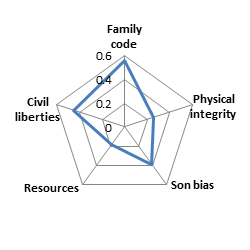
Family relations in Indonesia are governed by a combination of civil, informal customary, and Sharia (Islamic) law. The application of these laws is determined by the religion to which one is registered, with Muslim women only permitted to marry and divorce under Islamic law.[1] In terms of the formal legal system, the Marriage Law No. 1 of 1974 and the Compilation of Islamic Law in Indonesia codify the legal standards that govern marriage and divorce in Indonesia, with the latter subject to conformity of the former. However, in the province of Aceh, a strict form of Sharia law is implemented directly by the government: prompting the UN Committee on the Elimination of Discrimination against Women (CEDAW) to express concern in 2012 that the women of Aceh were subject to laws that severely discriminate against women with respect to family relations.[2]
Under the civil Marriage Law, the legal age of marriage is 16 years for women and 19 years for men.[3]Although Law No. 23 of 2002 on Child Protection recommends that the legal age for both men and women be 18 years, it does not mandate it. Marriage patterns vary between regions and ethnic groups. While rates of early marriage are falling, the Government reports that early marriage is prevalent, especially in rural areas.[4] A 2012 United Nations report drawing on data from 2010 estimated that 14.4% of all Indonesian girls between 15 and 19 years of age were married, divorced or widowed, as compared to 6.1% of boys.[5] The government has conducted public relations campaigns that encourage delaying marriage, continuing education for both boys and girls, limiting family size, and promoting men to take a greater role in family life. It also recently prosecuted a high profile case against a man that married a girl of 12.[6] While the Marriage Law forbids forced marriages, the Indonesia National Commission on Violence against Women notes that in certain communities in Indonesia, there is a practice of forcing young couples into marriage when they are caught in extra-marital relations (muhrim).[7]
Indonesia’s Marriage Law explicitly states that men are the head of the household, although men and women share parental authority equally.[8]
Under Indonesian civil law, women and men have equal rights to inheritance.[9] However inheritance practices vary widely between different regions and ethnic groups. Where Islamic law is practiced, inheritance favours male heirs over female heirs, stipulating that the inheritance ratio for sons to daughters is two to one.[10] However, although this rule is applied in regions such as Aceh, some Muslim areas, such as Java, usually ensure this law for equal inheritance between daughters and sons[11]; whereas a recent study shows that some indigenous groups pass down land rights from mother to daughter.[12] It would appear that following the Constitutional Court Decision (No. 46/PUU-VIII/2010), illegitimate children who are born of mixed couples also have inheritance rights from their biological father.[13]
More
Polygamy is legal in Indonesia, but the Marriage Law of 1974 states that permission to have multiple wives can only be granted if a man can provide evidence that his first wife is unable to carry out her responsibilities as a wife, is suffering from a physical disability or falls victim to an incurable disease, or is unable to bear children.[14]
The civil Marriage Law is intended to apply to all non-Muslim Indonesians, provided that they have registered their marriage as one of the recognized religious unions stipulated by the State: an act which human rights organisations report to be much more difficult for religious minorities in Indonesia.[15] NGOs report that in practice, the law often excludes women, often religious minorities, who have undergone traditional marriage ceremonies which are not registered with the State; effectively denying these women the opportunity to avail themselves of the court system to enforce their rights during divorce including the division of property and child support.[16] According to the National Commission on Violence against Women (or Komnas Perempuan), the practice of unregistered marriage are crimes against the marriage law and perpetuate violence against women. Unregistered marriage is often a way for men to avoid legal responsibility towards their wives and children. Komnas Perempuan reported that in the first half of 2012, it received 96 cases of crime linked to marriage: out of these, 41 wives reported that their husbands were having an affair and 20 wives reported that their husbands remarried with another woman without their permission, which caused them physical and psychological suffering and made them economically vulnerable. Several wives reported that they did not know their husbands were already married.[17]
Women and men have the same rights to divorce under the civil marriage law, and the Compilation of Islamic Law also provides women with the right to initiate divorce. [18] However, in practice the formal law is not always followed, particularly in rural areas where cultural practices and more restrictive interpretations of Islamic law curtail women’s equality within marriage. In addition, the laws that govern the province of Aceh explicitly limit women’s rights to divorce under Sharia law.[19]Although domestic violence is grounds for a woman to file for divorce, the government reported to the UN Committee on the Elimination of Discrimination against Women (CEDAW) that in some cases, judges in religious courts are reluctant to grant a divorce even in these circumstances.[20] While the law requires a divorced woman to wait 40 days before remarrying, a man can remarry immediately.[21]
[1] CEDAW (2012), p.14 [2] CEDAW (2012), p.15 [3] Marriage Law No. 1 of 1974, Article 7 [4] CEDAW (2011) [5] UN (2012) [6] CEDAW (2011), p.70 [7] Indonesia National Commission on Violence against Women (2011), para 25 [8] CEDAW (2005), pp. 56-57 [9] CEDAW (2011), p.66 [10] Compilation of Islamic Law (Presidential Instruction No. 1 of 1991), Article 176 [11] USAID (n.d.), p.9 [12] Cunningham (2007) [13] Tutik, T. T. and Iain, S. A (2013) [14] Marriage Law No. 1 of 1974, Article 4 [15] Indonesia National Commission on Violence against Women (2011), para 66 [16] Indonesia National Commission on Violence against Women (2011), para 63 [17] National Commission on Violence Against Women (2014) [18] Bedner and Huis (2010) [19] US State Department (2013) [20] CEDAW (2011), p.73 [21] US State Department (2013)
In recent years, the Government of Indonesia has adopted a number of policies and strategies to combat violence against women, including: the adoption of a national action plan on human rights for the period 2011-2014; minimum service standards on integrated services for women and children victims of violence; and the establishment of more than 400 institutions to handle cases of violence against women at national, provincial and district levels. [22] The majority of these institutions are police units for women and children (305 units), followed by Integrated Service Centres (113 units), and crisis centres at hospitals (63 units). [23] There are also 42 women’s crisis centres managed by women’s groups in more than 20 provinces.[24] However, the government has noted that these services often do not extend into rural areas, and are generally under-resourced.[25]
Domestic violence is considered a private matter and incidents are rarely reported, with victims facing considerable social pressure not to speak out.[26] As such, it is difficult to ascertain how frequently it occurs. However, the 2011 UN Committee on the Elimination of Discrimination against Women (CEDAW) report notes that in 2006, 41% of documented cases of divorce going through the Religious Courts cited involved domestic violence, while the Indonesia National Commission on Violence against Women recorded 105,103 cases of violence against women in 2010, 90 % of which were domestic violence.[27] Recent evidence indicates that public acceptance of domestic violence may be increasing among women. According to a 2003 Demographic and Health Survey, almost 25% of women who are or once were married agree that a husband is justified in beating his wife for any of the following reasons: she burns the food; she argues with him; she goes out without telling him; she neglects the children; or she refuses to have sex with him.[28] When asked again during the 2007 survey, the total had risen to over 30%. These numbers were highest among poor and young women, and those with little to no education.[29] According to a 2013 UN survey, the proportion of ever-partnered men who reported ever having perpetrated physical and/or sexual intimate partner violence in their lifetime varied from 26% in rural Indonesia to 30% in urban centres and 60% in Papua;[30] sexual violence was reported to be more common than physical violence in all three sites in Indonesia.[31]
The Elimination of Domestic Violence Law No. 23 was introduced in 2004, followed by the Witness Protection Act No.13 in 2006, which includes provisions for temporary protection orders and counselling for survivors.[32] However, the Government’s 2011 report to the UN Committee on the Elimination of Discrimination against Women (CEDAW) notes that women seeking to use the law to obtain justice in cases of domestic violence have found the process to be lengthy, complicated, and ultimately ineffective.[33] Further, women’s organizations report that even though the Domestic Violence Law makes domestic violence a crime, the Compilation of Islamic Law still allows domestic violence against wives, as provided for under article 48.[34]
Rape is a punishable offence in Indonesia, with punishments ranging from 4 to 14 years imprisonment.[35] However, the law has some weaknesses, including: the failure to criminalize marital rape under the Criminal Code and the absence of any reference to rape or marital rape in the law on domestic violence; and the requirement of two elements of proof (for example testimony from the victim, the defendant, or an expert), which in reality can be very difficult for victims to demonstrate.[36] Additionally, implementation of the law is frustrated by the small number of cases of rape and sexual assault brought to court; the lenient punishments meted out to those convicted; and practices such as the mediation of the police in rape cases, the payment of a fine as the settlement of the case, or the practice of marrying the victim to the rapist.[37] Official figures of rape are difficult to obtain; however a 2013 comprehensive UN survey reports that 5.8% of rural men, 8.5% or urban men and 23.5% of men interviewed in Papua admitted to have committed rape of a non-partner[38]; while 1.5% of rural men, 2.0% or urban men and 6.8% of men interviewed in Papua admitted to have committed gang rape. [39] The most common motivation given by respondents who had admitted to having committed rape was sexual entitlement. [40]
As reported by the US Department of State, a study conducted by the Indonesian Ministry of Health in 2004 found that 90% of women (and 25% of men) claimed to have been subjected to some form of sexual harassment in the workplace.[41] Sexual harassment can be prosecuted under the Criminal Code as an “indecent public act”[42], although women’s organizations report that due to the absence of rules and a clear legal definition of sexual harassment in the Penal Code, many cases are difficult to prosecute and victims are unwilling to come forward. [43]However the Indonesia National Commission on Violence against Women has received reports that indicate the problem is widespread[44], with female migrant workers are reported to be especially vulnerable.[45]
In April 2006, the Ministry of Health banned the practice of female genital mutilation (FGM), officially making it illegal for doctors and nurses to perform the procedure.[46] However, in 2010 that regulation was replaced by one that authorized certain medical practitioners to conduct ‘female circumcision’, following the issuance of two fatwas by the Indonesian Council of Ulemas.[47] The UN Committee on the Elimination of Discrimination against Women (CEDAW) has since expressed concern about the serious regression with regard to the practice of all forms of FGM, including female circumcision;[48] and the Government reports that FGM is still practised in some parts of the country by groups claiming the act is largely symbolic and not a real threat to women’s health.[49]
More
Indonesia has also experienced a number of cases of violence against women perpetrated by the State in the context of the civil conflicts between 1965 and 1999, as well as the conflicts in Aceh Province, in East Java and Papua Provinces. Although the government has recognised these crimes, the UN Committee on the Elimination of Discrimination against Women (CEDAW) noted its concern about the lack of progress in providing women victims of sexual violence with justice, truth, reparation and rehabilitation for such human rights violations.[50]
Despite the positive introduction of Law No. 21 of 2007 on the eradication of the crime of trafficking in persons, trafficking and prostitution pose serious threats for Indonesian girls and women, as Indonesia remains a major source country and to a much lesser extent a destination and transit country for sex trafficking and forced labour.[51]Although the Government has recently created the first database for tracking trafficking convictions to improve the centralized collection of data on prosecutions and victim protection from local governments, exact numbers of women and children trafficked within the country and abroad are not yet available. The US State Department reports that, while Indonesian National Police investigators used the 2007 anti-trafficking law to prepare cases for prosecution, some prosecutors and judges are still reluctant to use the law. Moreover, it reported that law enforcement officials complained about the difficulty of coordinating among police, prosecutors, witnesses, and courts to obtain successful convictions; and provincial governments’ funding of victim protection services varied greatly.[52]
Abortion is only legal in cases where medical emergencies detected from the early age of pregnancy threaten either the life of the mother or child; or in the case of pregnancy resulting from rape. Law No. 36 of 2009 on Health provides counselling services related to the decision and guarantees women’s rights to be free from violence in the form of forced abortions. However, even for those women legally entitled to abortion, these services are only available within the first six weeks of pregnancy;[53] and, with the exception of rape victims, married women must seek the approval of their husbands.[54]Women’s groups also report that there appears to be reluctance amongst some health workers to provide women and girls with access to safe abortion services, on the grounds of moral or religious convictions.[55]
Women in Indonesia have the right to use contraception, and to access information about reproductive health and family planning.[56] However, under Articles 72 and 78 of the Health Law, access to sexual and reproductive health services may only be provided to “legal partners”, which implies that in practice only married couples can access family planning services,[57] and reflects the social stigma experienced by women and girls who have sex outside marriage (or are believed to have done so).[58] Additionally, some methods of contraception require a husband’s consent.[59]
Indonesia has run a national family planning program to reduce the fertility rate since the 1990s, which includes contraceptives and irreversible contraceptive methods, although the rate of male participation remains low.[60] Knowledge of modern methods of contraception among married women in Indonesia top 98%, according to the 2012 Demographic and Health Survey (DHS).[61] Usage rates are also quite high: more than 80% of ever-married women had used a modern method of contraception at some point, and more than 54% were doing so at the time of the 2007 DHS.[62] Among women who were not using contraception, nearly half discontinued use for either fertility or health-related reasons.[63] Overall, just 9.7% of women reported an unmet need for family planning, either from a desire to increase the period of time between births, or a desire to limit their overall number of children.[64] This suggests that women do not face obstacles in the form of social or religious customs in regard to accessing contraception.
[22] CEDAW (2012), p.6 [23] CEDAW (2012), p.6 [24] Indonesia National Commission on Violence against Women (2011), p.4[25] CEDAW (2011), p.19 [26] CEDAW (2005), p. 26 [27] Indonesia National Commission on Violence against Women (2011), para 16 [28] BPS and ORC Macro (2008), Table 3.12 [29] BPS and ORC Macro (2008), Table 3.12.1 [30] UNDP, UNFPA), UN Women UNV (2013), p.29 [31] UNDP, UNFPA, UN Women and UNV (2013), p.30 [32] UN Women (2011), p.xi [33] CEDAW (2011), p.68 [34] CEDAW (2007) [35] US State Department (2013) [36] Amnesty (2010), p.19 [37] CEDAW (2012), p.7 [38] UNDP, UNFPA, UN Women UNV (2013), p.40 [39] UNDP, UNFPA, UN Women UNV (2013), p.45 [40] UNDP, UNFPA, UN Women UNV (2013), p.45 [41] US State Department (2009) [42] US State Department (2013) [43] CEDAW (2011), p.17 [44] Indonesia National Commission on Violence against Women (2011), para 47 [45] Indonesia National Commission on Violence against Women (2011), para 37. [46] CEDAW (2011), p.46 [47] CEDAW (2012), p.5 [48] CEDAW (2012), p.5 [49] CEDAW (2011), p.46 [50] CEDAW (2012), p.8 [51] US State Department (2013b), p.198 [52] US State Department (2013b), p.200 [53] CEDAW (2012), p.12 [54] CEDAW (2012), p.12 [55] Amnesty (2010), p.36 [56] US State Department (2013) [57] Amnesty (2010), p.24 [58] [59] CEDAW (2012), p.12 [60] CEDAW (2011), p.50 [61] SINPFPB and MoH (2013), p.74 [62] BPS and ORC Macro (2008), Tables 5.9.1 and 6.1 [63] BPS and ORC Macro (2008), Table 8.4. [64] BPS and ORC Macro (2008), Table A-7.2.
The male-to-female sex ratio at birth is 1.05 and in the working age population (15-64) it is of 1.01.[65]
There is evidence to suggest that Indonesia is a country of low incidence of missing women given elevated sex ratios at birth.
More
Data from the 2012 Demographic and Health Survey (DHS) indicates that, of children under the age of two included in the survey, 65.9% of girls had received all their vaccinations, compared to 67.5% of boys.[66] Rates of under-five mortality were higher for boys than girls. Overall, this would not indicate bias towards sons in regard to early childhood care. Enrolment and attendance rates at primary school were the same for girls and boys, and attendance rates at secondary school were higher for girls, according to UNICEF.[67]
[65] CIA (2013) [66] SINPFPB and MoH (2013),Table 10.3 [67] UNICEF (2013), Table 5
Indonesia’s Civil Code stipulates that men and women have equal ownership rights, and women have full rights concerning secure access to land and non-land assets.[68] However, despite the fact that Article 35 of the 1974 Marriage law formally adopts the concept of joint ownership of property purchased during marriage or marital property, only few parcels of land are registered in the joint name of husband and wife. It is customary for the husband to register marital property in his name because he usually attends to paperwork related to land.[69]
In the event of divorce, civil law stipulates that both spouses retain whatever property they owned individually prior to the marriage and must divide equally any joint property.[70] Article 65 of the Compilation of Islamic Law also provides that in case of divorce each wife to a polygamous marriage has an equal right to property that was acquired since the time of her marriage, although this guarantee applies only to registered marriages. In the post-Tsunami reconstruction period, a policy of co-ownership of land was instigated, allowing women to register individually or communally as landowners, according to the 2011 UN Committee on the Elimination of Discrimination against Women (CEDAW) report.[71]
Officially, women also have equal access to financial services including bank loans and credit, and have the right to independently conclude contracts.[72]However, Article 108 of the Civil Code creates a significant barrier to the acquisition of assets, as it prevents married women from entering into contracts on their own behalf and from receiving any payment from individual business activities.[73] Although recent amendments to the law have extended the same co-signing requirement to husbands regarding contracts[74], the equality guaranteed by the law is not always enforced consistently[75] and as a consequence, married women find it difficult to engage in formal financial activities such as opening a checking account which could facilitate application for credit.[76] In the economic sector, special credits are available for women economic groups, for instance ‘perkassa’(credit schemes specifically for women in micro and small enterprises), launched in 2006-2007 with funds from the Ministry of Cooperatives, Small and Medium Enterprise.[77]
[68] CEDAW (2005), pp. 54-55 [69] ADB (2006) [70] CEDAW (2005), pp. 55, 58 [71] CWGI (2007), p. 52 [72] CEDAW (2005), pp. 49-50, 55 [73] UNDP (2010) [74] CEDAW (2011), p.54 [75] CWGI (2007), Independent Report of NGOs Concerning the Implementation of CEDAW in Indonesia, p. 52 [76] FAO (n.d) [77] CEDAW (2011), p.12
Women in Indonesia have freedom of access to public space in general, but Islamic law imposes restrictions in certain areas that significantly affect women’s freedom of movement. In 2012 the UN Committee on the Elimination of Discrimination against Women (CEDAW) expressed concern about several discriminatory by-laws, including those in the province of Aceh, which restrict women’s rights in the conduct of their daily life, including in social and public life; impose dress codes; restrict freedom of movement and association (for example, between unmarried people); and severely penalize alleged immoral relationships.[78] Since being introduced in 1999, the policy on attire has resulted in various acts of violence including forced haircuts, the dousing of victims with paint, the cutting of trousers and verbal as well as physical sexual harassment.[79] The Indonesia National Commission on Violence against Women reported that in one particular district, women who did not wear veils (jilbab) were not entitled to receive rice subsidies for poor residents.[80]
Freedom of speech, assembly and association are generally respected in Indonesia, although the media do operate under certain restrictions.[81] Freedom House reports that there are many active civil society organisations, and this would appear to include many working on women’s rights, including a very strong National Human Rights Mechanism dedicated to violence against women.[82] Nevertheless, the Indonesia National Commission on Violence against Women has noted that women human rights defenders face intimidation, torture, and stigmatization, some of which is gender-based – particularly those fighting for the rights of indigenous people or in conflicts related to natural resources.[83]
There are no formal barriers to women’s political participation, although traditionally, the political sphere is seen as the provenance of men.[84] However, public opinion polls provide some evidence that beliefs relating to gender equality in political life are increasing. Over 60% of respondents to a 2006 World Values Survey believed that men made better political leaders than women, although a Pew survey from 2007 found that when given the option to rate men and women equally, 52% did so, with 43% still saying that men performed better.[85]
With the aim of increasing women’s political participation, the Government of Indonesia adopted Law No. 2 of 2011 on political parties, establishing quotas for women in political party structures at the national and regional levels; and Law No. 8/2012, on general elections, in which provision is made for a 30% quota for women candidates on the electoral lists of political parties for the general elections of regional legislative bodies.[86] However, it is unclear how these laws operate in light of a 2008 Constitutional Court decision to strike down the quota system established for elections to the House of Representatives. [87]As of 2012 the UN Committee on the Elimination of Discrimination against Women (CEDAW) reported that participation of women in political and public life remained low, including in the House of Representatives (17.86%); the House of Regional Representatives (27%); the provincial houses of representatives (13%), the Supreme Court (4 of 49 judges) and the Constitutional Court (one of nine judges).[88]
More
Women in Indonesia who work are entitled to three months of paid maternity leave.[89] They receive 100% of their wages, which are paid for in full by their employer. In addition, pregnant and nursing women receive special protections against dangerous work, and they cannot be discriminated against or fired without cause unrelated to their pregnancy.[90] However, it is reported that many companies get around these requirements by hiring women as day labourers rather than as full-time employees, which means they are not entitled to maternity leave; [91] and workers found to be pregnant are often requested to resign by their companies and to re-apply once they have given birth.[92] Domestic workers, a high proportion of who are women, are excluded from the protections afforded to other workers by the Manpower Act of 2003, including on minimum wage, overtime pay, the number of hours worked per day, a weekly day of rest and social security. Due to this vulnerability, it is reported that domestic workers are especially vulnerable to psychological, physical, sexual, and economical violence.[93]
The Government of Indonesia reformed its discriminatory Citizenship Act in 2006 by conferring the right to pass on nationality to children irrespective of gender, marital status or spouse’s nationality.[94]However, a woman cannot transfer Indonesian citizenship to her child until that child reaches the age of 18. As the Government has recognized, a divorced non-citizen woman may consequently risk being separated from her underage children by deportation, which may inhibit her ability to flee from violent or unequal relationships.[95]A new decision of the Constitutional Court (No. 46/PUU-VIII/2010) gives civil rights to children born outside of unregistered marriages.[96]
[78] CEDAW (20120 p.4. [79] Indonesia National Commission on Violence against Women (2011), para 53 [80] Indonesia National Commission on Violence against Women (2011), para 50 [81] Freedom House (2013) [82] Freedom House (2013) [83] Indonesia National Commission on Violence against Women (2011), para 20 [84] CEDAW (2011), p.11 [85] CEDAW (2005), p. 21;World Values Survey (WVS) (2006), Question V61; Pew Research Center (2007), Question Q.4 [86] CEDAW (2012), p.2 [87] CEDAW (2012), p.9 [88] CEDAW (2012), p.9 [89] Law on Manpower Affairs 2003, Article 82 [90] ILO (n.d.) [91] US State Department (2013) [92] Indonesia National Commission on Violence against Women (2011), para 46 [93] CEDAW (2011), p.36 [94] Law of the Republic of Indonesia No. 12 of 2006 on Citizenship of the Republic of Indonesia, Article 4. [95] CEDAW (2011), p.26 [96] The Constitutional Court Of The Republic Of Indonesia (2010)
Amnesty International (2010) ‘Indonesia: Left without a choice: Barriers to reproductive health in Indonesia’, 4 November 2010, http://www.amnesty.org/en/library/asset/ASA21/013/2010/en/e0a63801-83d1-46b6-bc37-7cde2aa74daa/asa210132010en.pdf.
Asian Development Bank (ADB) (2006) ‘Country Gender Assessment: Indonesia’, manila, http://www.adb.org/Documents/Reports/Country-Gender-Assessments/cga-ino.pdf.
Badan Pusat Statistik-Statistics Indonesia (BPS) and ORC Macro (2003), Indonesia Demographic and Health Survey 2002-2003, BPS and ORC Macro, Calverton, MD.
Bedner, Adriaan and Stijn van Huis, ‘Plurality of Marriage Law and Marriage Registration for Muslims in Indonesia: A Plea for Pragmatism, Utrecht L. Rev. 175, 180, Volume 6, Issue 2 (June 2010), http://www.utrechtlawreview.org/index.php/ulr/article/viewFile/130/130.
BPS and ORC Macro (2008), Indonesia Demographic and Health Survey 2007, BPS and ORC Macro: Calverton, Maryland, USA.
CEDAW (2011) Consideration of reports submitted by States parties under article 18 of the Convention on the Elimination of All Forms of Discrimination against Women Combined sixth and seventh periodic reports of States parties Indonesia, CEDAW/C/IDN/6-7, CEDAW, New York.
CEDAW (2007) Concluding comments of the Committee on the Elimination of Discrimination against Women: Indonesia, CEDAW/C/IDN/CO/5, New York.
CEDAW (2005), Consideration of Reports Submitted by States Parties Under Article 18 of the Convention on the Elimination of All Forms of Discrimination against Women: Indonesia, Combined Fourth and Fifth Periodic Reports of States Parties, CEDAW/C/IDN/4-5, CEDAW, New York, NY.
CEDAW Working Group Initiative (CWGI) (2007), Independent Report of Non-Government Organizations Concerning the Implementation of the Convention on the Elimination of all Forms of Discrimination against Women (CEDAW) in Indonesia, CWGI: Jakarta, Indonesia.
Central Intelligence Agency (CIA) (2013) ‘The World Factbook: Indonesia’, online edition, Washington, D.C.: CIA, https://www.cia.gov/library/publications/the-world-factbook/geos/id.html.
Committee on the Elimination of Discrimination against Women (CEDAW) (2012) Concluding comments of the Committee on the Elimination of Discrimination against Women: Indonesia, CEDAW/C/IDN/CO/6-7, New York.
Cunningham, C. (2007), ‘Indonesia: Inheritance’, http://family.jrank.org/pages/867/Indonesia-Inheritance.html.
Freedom House (2013) ‘Freedom in the World Country Reports: Indonesia’, http://www.freedomhouse.org/report/freedom-world/2013/indonesia.
Indonesia National Commission on Violence against Women (Komisi Nasional anti Kekerasanterhadap Perempuan - Komnas Perempuan), ‘National Human Rights Institution Independent Report Regarding the Implementation of the Convention on the Elimination of All Forms of Discrimination against Women in Indonesia, 2007 – 2011 Submitted to the CEDAW Committee’, 8 October 2011, http://tbinternet.ohchr.org/Treaties/CEDAW/Shared%20Documents/IDN/INT_CEDAW_NGO_IDN_52_9020_E.pdf.
International Labour Organization (ILO) (n.d), ‘Database of Conditions of Work and Employment Laws’, ILO: Geneva, Switzerland.
National Commission on Violence Against Women (2014), Press Release: Response to the Supreme Court Decision on Garut Mayor, Aceng Fikri, http://www.komnasperempuan.or.id/en/2013/02/press-release-response-to-the-supreme-court-decision-on-garut-mayor-aceng-fikri/ [accessed 04/06/2014].
Pew Research Center (2007), ‘Global Attitudes Project: Spring 2007 Survey’, Pew Research Center, Washington, DC.
Statistics Indonesia National Population and Family Planning Board (SINPFPB) and Ministry of Health (MoH) (2013), ‘Indonesia Demographic and Health Survey 2012’, August 2013, http://www.measuredhs.com/pubs/pdf/FR275/FR275.pdf.
The Constitutional Court Of The Republic Of Indonesia (2010), Decision Number 46/Puu-Viii/2010, For The Sake Of Justice Under The One Almighty God, http://www.mahkamahkonstitusi.go.id/putusan/putusan_sidang_eng_putusan_sidang_46%20PUU%202010-TELAH%20BACA%20(ENG).pdf [accessed 04/06/2014].
Tutik, T. T. and Iain, S. A (2013), Implications of the Verdict of Constitutional Court Number 46/PUU-VIII/2010 on the Hereditary Right of Illegitimate Children Born of Mixed Couple in Islamic Law Perspective, http://papers.ssrn.com/sol3/papers.cfm?abstract_id=2297279, [accessed 04/06/2014].
UN (2012), ‘World Marriage Data 2012’, UN Department of Economic and Social Affairs, Population Division, New York, NY, http://www.un.org/esa/population/publications/WMD2012/MainFrame.html.
UN (2012b), ‘World Contraceptive Use 2012’, http://www.un.org/esa/population/publications/WCU2012/MainFrame.html, (last accessed 1 December 2013).
UN Women (2011), ‘Domestic Violence Legislation and its Implementation: An Analysis for ASEAN Countries based on International Standards and Good Practices’, http://cedaw-seasia.org/docs/DomesticViolenceLegislation.pdf, (last accessed 21 December 2013).
United Nations Development Fund (UNDP), United Nations Fund for Population Affairs (UNFPA), UN Women and United Nations Volunteers (UNV) (2013) ‘Why Do Some Men Use Violence Against Women and How Can We Prevent It? Partners for prevention A UNDP, UNFPA, UN Women and UNV regional joint programme for gender-based violence prevention in Asia and the Pacific: Quantitative Findings from the United Nations Multi-Country Study on Men and Violence in Asia and the Pacific’ September 2013, http://unwomen-asiapacific.org/docs/WhyDoSomeMenUseViolenceAgainstWomen_P4P_Report.pdf, (last accessed 21 December 2013).
UNDP (2010) ‘The Asia Pacific Human Development report: Power Voice and Rights: A Turning point for Gender Equality in Asia and the Pacific’, http://hdr.undp.org/en/reports/regional/asiathepacific/RHDR-2010-AsiaPacific.pdf, (last accessed 15 November 2013).
UNICEF (2013), ‘State of the World's Children Report 2013’, UNICEF (2013), http://www.unicef.org/mena/MENA_SOWC_Report_2013_ENG(1).pdf, (last accessed 21 December 2013).
USAID (n.d.) ‘Indonesia – land tenure and property rights profile’, http://usaidlandtenure.net/sites/default/files/country-profiles/full-reports/USAID_Land_Tenure_Indonesia_Profile_0.pdf.
US Department of State (2013), ‘2012 Country Reports on Human Rights Practices: Indonesia’, US Department of State, Bureau of Democracy, Human Rights and Labor, Washington, DC, http://www.state.gov/j/drl/rls/hrrpt/humanrightsreport/#wrapper, (last accessed, 15 November 2013).
US Department of State (2013b) ‘Trafficking in Persons Report 2013’ Department of State, Bureau of Democracy, Human Rights and Labor, Washington DC, http://www.state.gov/documents/organization/210737.pdf, (last accessed 15 November 2013)
US Department of State (2010), 2009 Country Reports on Human Rights Practices: Indonesia, US Department of State, Bureau of Democracy, Human Rights and Labor, Washington, DC.